Tag: digital transformation

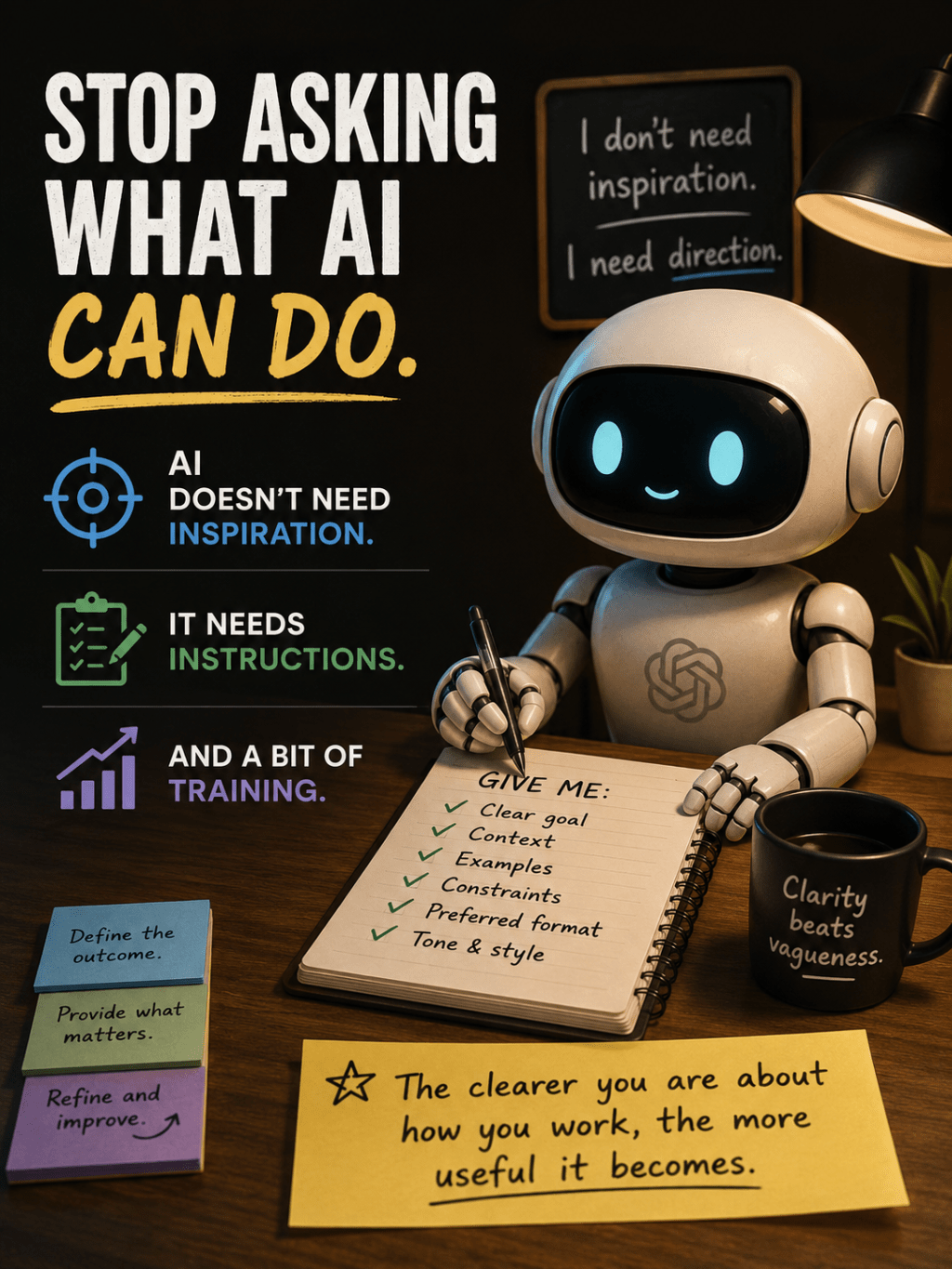
  • Stop Asking What AI Can Do

    Stop Asking What AI Can Do

    Most people ask the wrong question about AI.

    “What can AI do for me?”

    That’s like hiring someone and then asking what skills they happen to have. Nobody competent works that way.

    You start with the job. You define what you need. You break the work down. Then you hire for that. And once you hire, you train. You give context. You correct. You refine.

    AI is no different.

    Look at your actual day. Status updates. Follow-ups. Notes. Deck edits. Repeating yourself in different formats. Break that chaos into the smallest possible tasks and hand them off.

    AI doesn’t need inspiration. It needs instructions. And a bit of training. The clearer you are about how you work, the more useful it becomes.

    Used this way, it’s not a replacement. It’s leverage. It doesn’t change who you are. It just gives you more surface area to operate.

    Stop admiring the tool. Start assigning it work.

    #midnightmusings from the trenches of delivery.

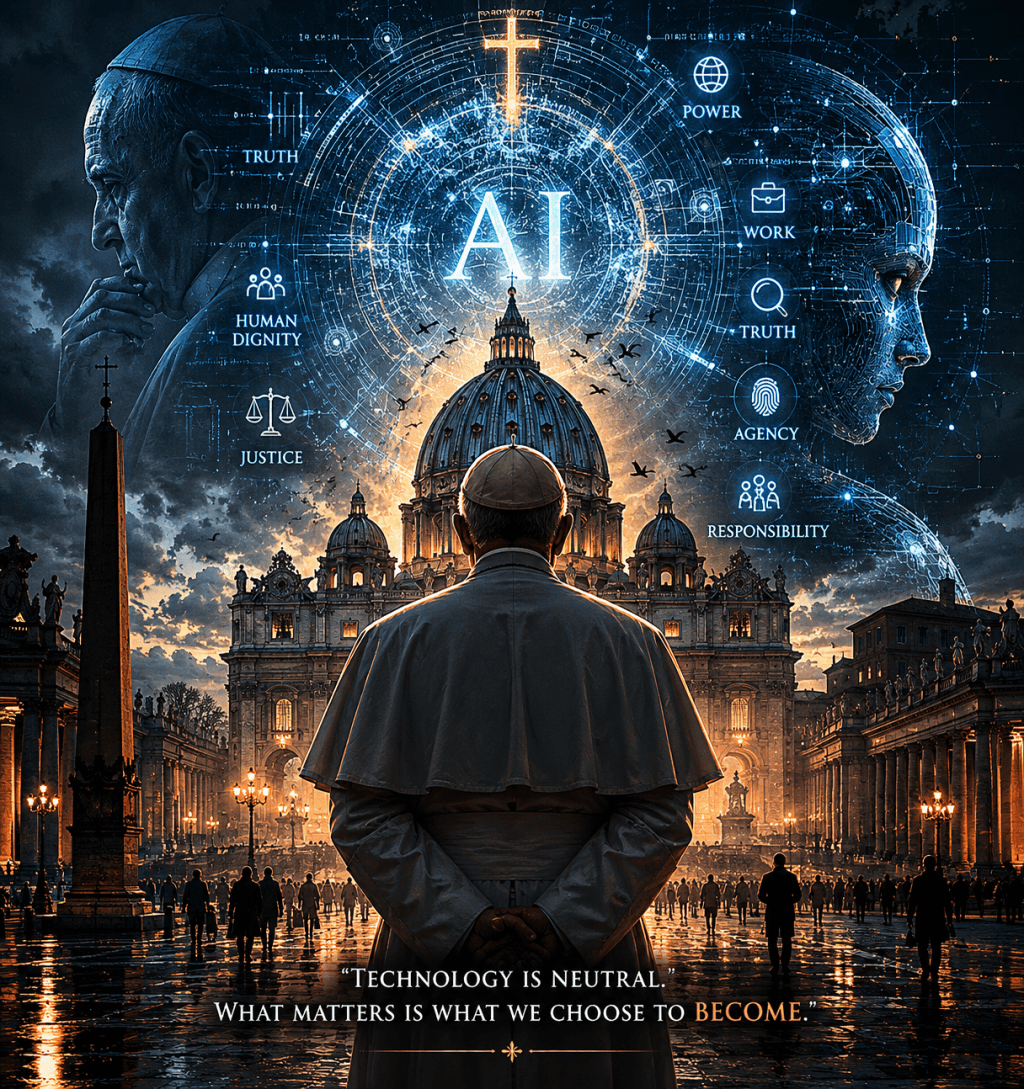
  • When the Vatican Starts Writing About AI

    When the Vatican Starts Writing About AI

    Pope Leo XIV just released a 245-page encyclical on Artificial Intelligence.

    You know things are getting serious when a 2,000-year-old institution decides AI needs formal doctrine.

    The Vatican’s new AI encyclical is not really about technology. It’s about power, labor, truth, identity, and what happens when human intelligence itself becomes industrialized.

    That’s the shift.

    AI is no longer a “tech trend.”
    It is becoming infrastructure for society itself.

    The Church has historically stepped into moments where technology reshaped humanity:

    • Industrialization
    • Nuclear weapons
    • Global capitalism

    Now AI joins that list.

    And beneath the religious framing sits an uncomfortable secular reality:
    Every major institution now understands AI is going to fundamentally alter how civilization operates.

    Governments.
    Education.
    Media.
    Law.
    Work.
    Trust.
    Human agency itself.

    This is no longer a conversation about productivity tools or chatbot demos.

    Once institutions built to think in centuries start treating AI as a moral and societal question, you are no longer in an innovation cycle.

    You are in an epoch shift.

    Humanity, naturally, appears determined to navigate this transition with deep wisdom and maturity. Right after deepfake propaganda, autonomous weapons, and emotionally dependent chatbot relationships. Spectacular species behavior.

    #Midnightmusings from the trenches of delivery.

    Visuals by AI. Reflections by experience.

  • AI Has Changed The Cost of Waiting

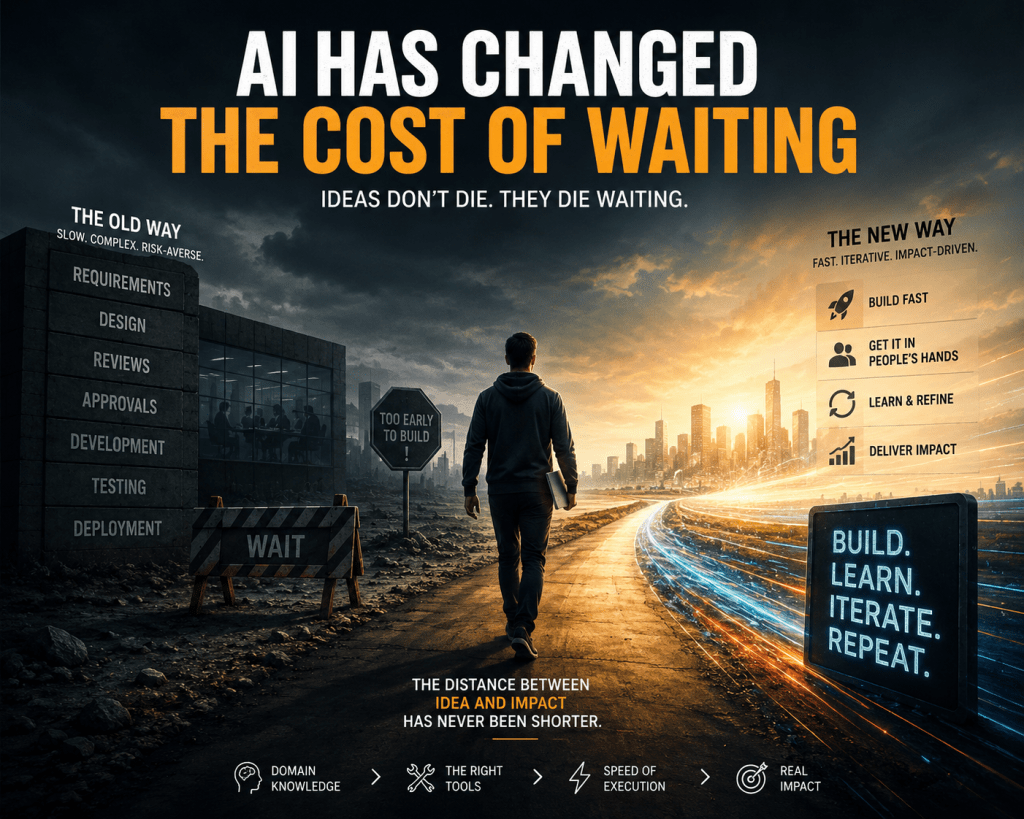
    AI Has Changed The Cost of Waiting

    In the last post, I wrote about how the people winning with AI aren’t necessarily the best coders.

    They’re the people who understand their domain deeply enough to build.

    But there’s another shift happening underneath that.

    Speed.

    A few months ago, I watched two very different approaches to the same AI-driven idea.

    One treated it like a traditional software project:
    planning, reviews, alignment, architecture discussions, phased execution.

    The other approach was simpler:
    build fast, get it into people’s hands, refine as you go.

    That contrast stayed with me.

    Because AI is collapsing the distance between idea and execution.

    A domain expert with clarity and the right tools can now prototype faster than many organizations can align internally.

    And that changes things dramatically.

    The advantage is no longer just technical skill.

    It’s speed of understanding.
    Speed of iteration.
    Speed of decision-making.

    Many organizations are still operating with waterfall thinking in a world where experimentation has become almost free.

    AI rewards people who are hands-on.
    People close to the actual business problem.
    People willing to fail fast and refine in public.

    Which raises an uncomfortable question:

    If everyone starts building this quickly, what happens to stability, architecture, governance, and long-term maintainability?

    That’s probably where the real conversation begins.

    #Midnightmusings from the trenches of delivery.

  • The People Winning With AI Aren’t the Best Coders

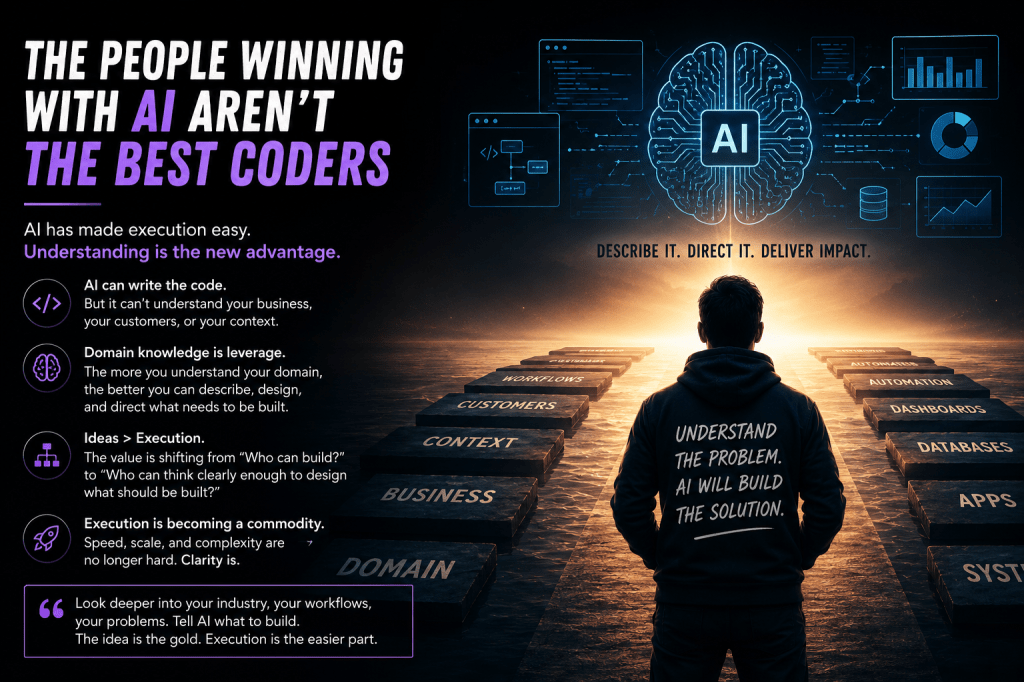
    The People Winning With AI Aren’t the Best Coders

    That’s the wrong conversation.

    A few years ago, building software meant technical skill. You needed engineers, architects, specialists, infrastructure teams, databases, deployment pipelines – the whole machinery.

    Now?

    You can build surprisingly complex workflows, dashboards, automations, apps, even lightweight platforms using plain language. Tools like ChatGPT, Gemini, Claude, Cursor, Lovable, Replit – they’ve flattened the technical barrier faster than most organizations realize.

    The bottleneck is no longer execution.

    It’s understanding.

    A few weeks ago, Girish made an observation that stuck with me:

    “Knowing your domain is becoming more important than being technically excellent.”

    And honestly, that might be the biggest shift AI is creating right now.

    The people getting ahead with AI aren’t necessarily the best programmers. They’re the people who deeply understand their domain. Their customers. Their workflows. Their operational pain points. Their industry logic.

    Because AI can generate code.

    But it cannot invent clarity.

    If you truly understand how your business works, you can now describe it, structure it, refine it, and have AI build around it at absurd speed.

    That changes the game completely.

    The value is shifting from “Who can build?” to “Who can think clearly enough to design what should be built?”

    Ideas are becoming leverage.

    Context is becoming leverage.

    Conceptualization is becoming leverage.

    Execution is slowly turning into the cheaper commodity.

    And that creates a second shift that most organizations still haven’t fully understood:

    When execution becomes easier, speed starts mattering more than process.

    The teams that learn fastest may soon outperform the teams that plan the longest.

    And honestly, that changes leadership, delivery, and product development more than AI itself.

    More on that in the next post.

    #Midnightmusings from the trenches of delivery.
  • The Smartest Tool in the Room

    The Smartest Tool in the Room

    This thought began while we were evaluating new Professional Services Automation (PSA) platforms — every vendor pitching their “AI-powered, all-in-one” solution to simplify delivery, optimize resources, and predict success before kickoff.

    Sounds brilliant. Except every program manager knows the truth: none of these tools truly talk to each other.

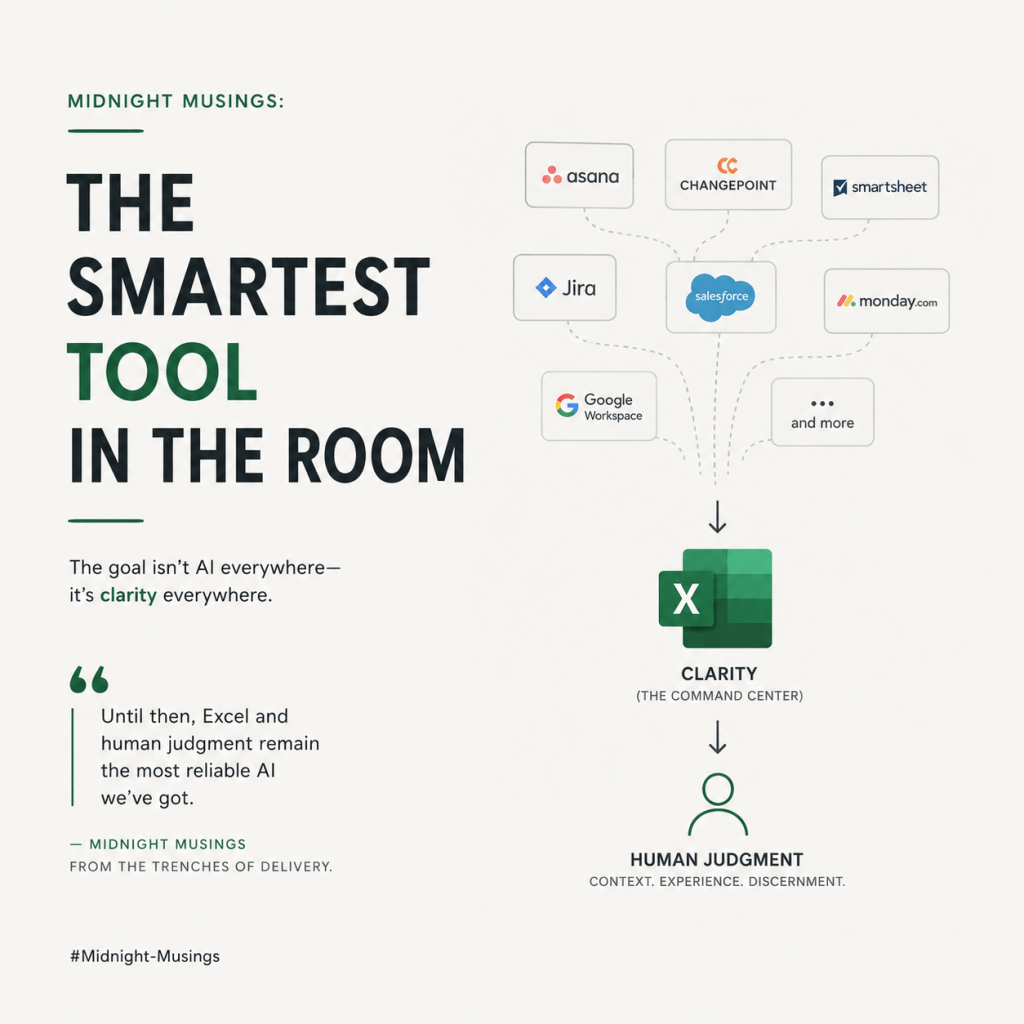
    We live surrounded by “smart” systems — Asana, Changepoint, Smartsheet, Jira, Salesforce, Monday.com, Google Workspace — yet we still spend hours stitching them together. Each tool works in isolation, but together? They’re chaos wrapped in APIs.

    That’s why, even in 2026, Excel remains the command center. It’s where all the scattered data finally makes sense. Because no matter how advanced the tech gets, AI still can’t replace human judgment, context, and the ability to simplify.

    The goal isn’t AI everywhere — it’s clarity everywhere.

    Until then, Excel and human judgment remain the most reliable AI we’ve got.

    — Midnight musings from the trenches of delivery.
    #Midnight-Musings

  • Writing with a Machine

    Writing with a Machine

    I like to think I write reasonably well.

    The vocabulary is there. The ideas usually show up. But over the past year, most of my emails, presentations, and even these Midnight Musings have had a quiet collaborator – AI.

    Not because I can’t write.

    Because it gets me to the point faster.

    Left to myself, I tend to wander through sentences and circle the idea before landing on it. AI trims the fluff, tightens the structure, and pushes the message to its conclusion.

    It doesn’t replace thinking. It compresses it.

    There’s a quote often attributed to Mark Twain: “I didn’t have time to write a short letter, so I wrote a long one instead.”

    Clarity takes work. Brevity takes more.

    AI just helps remove everything that isn’t the message.

    And in a world drowning in words, that might be its most useful skill.

    #midnightmusings from the trenches of delivery.