Tag: delivery management

  • AI Is Creating a New Class of Program Managers

    AI Is Creating a New Class of Program Managers

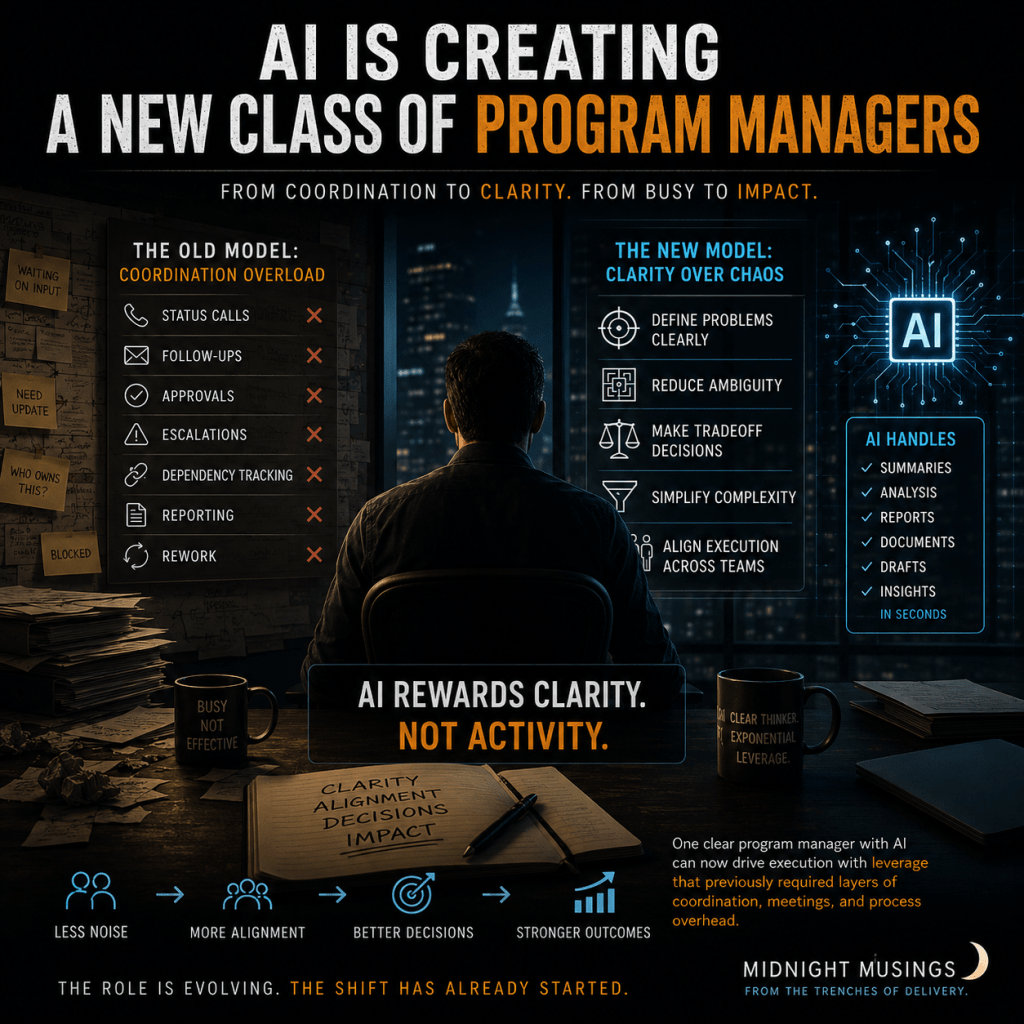
    For years, program management optimized around coordination.

    Status calls.
    Follow-ups.
    Approvals.
    Escalations.
    Dependency tracking.

    A large part of program management became operational middleware between disconnected teams, systems, and stakeholders.

    AI is starting to change that.

    Not because it replaces delivery managers.
    Because it commoditizes execution support.

    Presentations, summaries, reporting, analysis, documentation, planning drafts. Machines can now generate acceptable first versions in seconds.

    The advantage is shifting elsewhere.

    Toward delivery leaders who can:

    • define problems clearly
    • reduce ambiguity
    • make tradeoff decisions
    • simplify complexity
    • align execution across teams

    AI rewards clarity.
    Not activity.

    The highest-value delivery managers are no longer the people producing the most artifacts.

    They are the ones creating the most alignment.

    Because one clear operator with AI can now drive execution with leverage that previously required layers of coordination, meetings, and process overhead.

    The role is evolving faster than most organizations realize.

    And the shift has already started.

    #Midnightmusings from the trenches of delivery.
  • AI Has Changed The Cost of Waiting

    AI Has Changed The Cost of Waiting

    In the last post, I wrote about how the people winning with AI aren’t necessarily the best coders.

    They’re the people who understand their domain deeply enough to build.

    But there’s another shift happening underneath that.

    Speed.

    A few months ago, I watched two very different approaches to the same AI-driven idea.

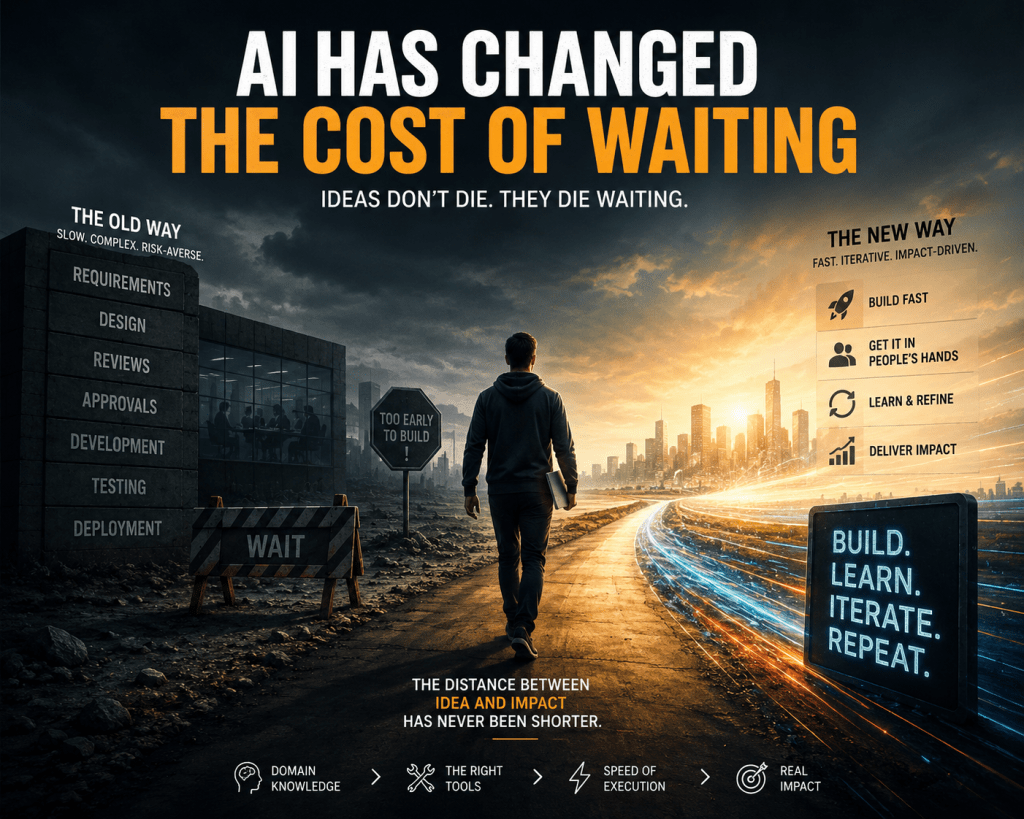
    One treated it like a traditional software project:
    planning, reviews, alignment, architecture discussions, phased execution.

    The other approach was simpler:
    build fast, get it into people’s hands, refine as you go.

    That contrast stayed with me.

    Because AI is collapsing the distance between idea and execution.

    A domain expert with clarity and the right tools can now prototype faster than many organizations can align internally.

    And that changes things dramatically.

    The advantage is no longer just technical skill.

    It’s speed of understanding.
    Speed of iteration.
    Speed of decision-making.

    Many organizations are still operating with waterfall thinking in a world where experimentation has become almost free.

    AI rewards people who are hands-on.
    People close to the actual business problem.
    People willing to fail fast and refine in public.

    Which raises an uncomfortable question:

    If everyone starts building this quickly, what happens to stability, architecture, governance, and long-term maintainability?

    That’s probably where the real conversation begins.

    #Midnightmusings from the trenches of delivery.
  • The Smartest Tool in the Room

    The Smartest Tool in the Room

    This thought began while we were evaluating new Professional Services Automation (PSA) platforms — every vendor pitching their “AI-powered, all-in-one” solution to simplify delivery, optimize resources, and predict success before kickoff.

    Sounds brilliant. Except every program manager knows the truth: none of these tools truly talk to each other.

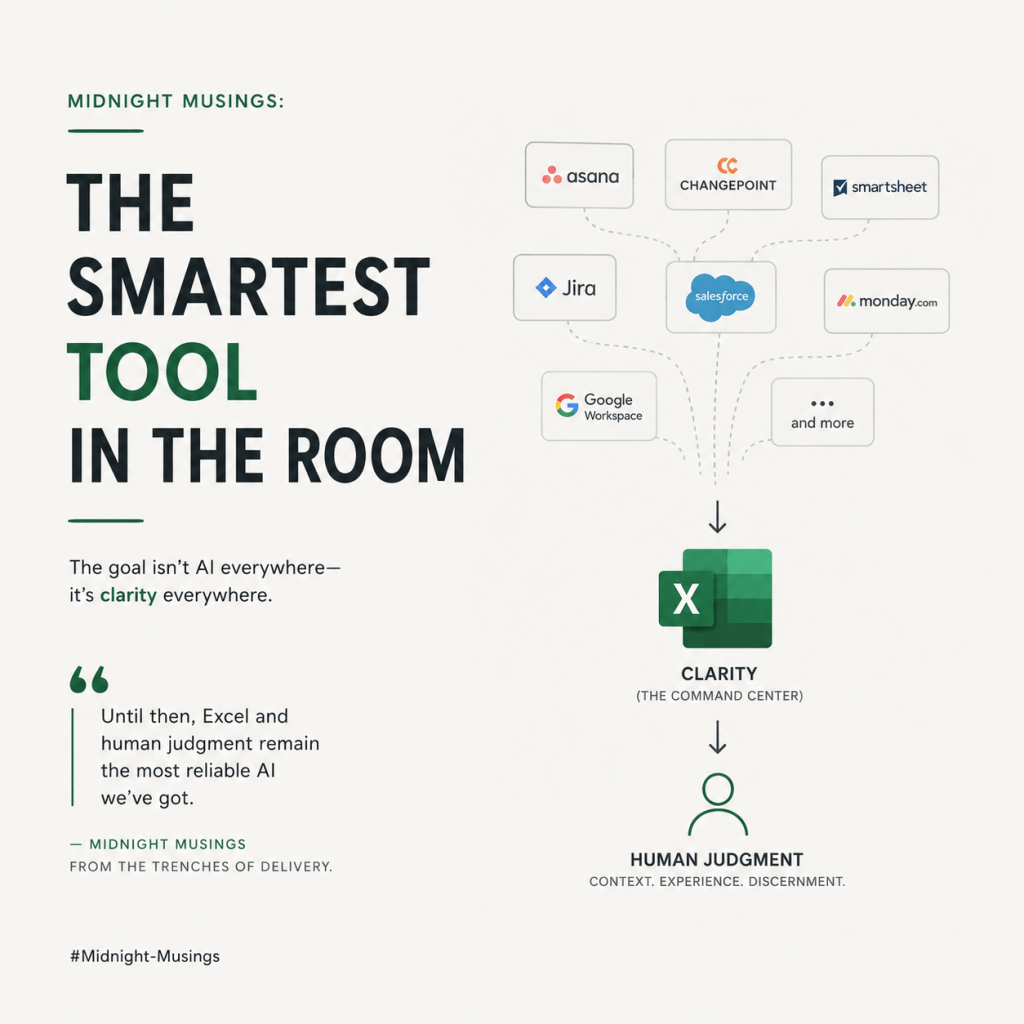
    We live surrounded by “smart” systems — Asana, Changepoint, Smartsheet, Jira, Salesforce, Monday.com, Google Workspace — yet we still spend hours stitching them together. Each tool works in isolation, but together? They’re chaos wrapped in APIs.

    That’s why, even in 2026, Excel remains the command center. It’s where all the scattered data finally makes sense. Because no matter how advanced the tech gets, AI still can’t replace human judgment, context, and the ability to simplify.

    The goal isn’t AI everywhere — it’s clarity everywhere.

    Until then, Excel and human judgment remain the most reliable AI we’ve got.

    — Midnight musings from the trenches of delivery.
    #Midnight-Musings

  • The Smartest Person In The Room

    The Smartest Person In The Room

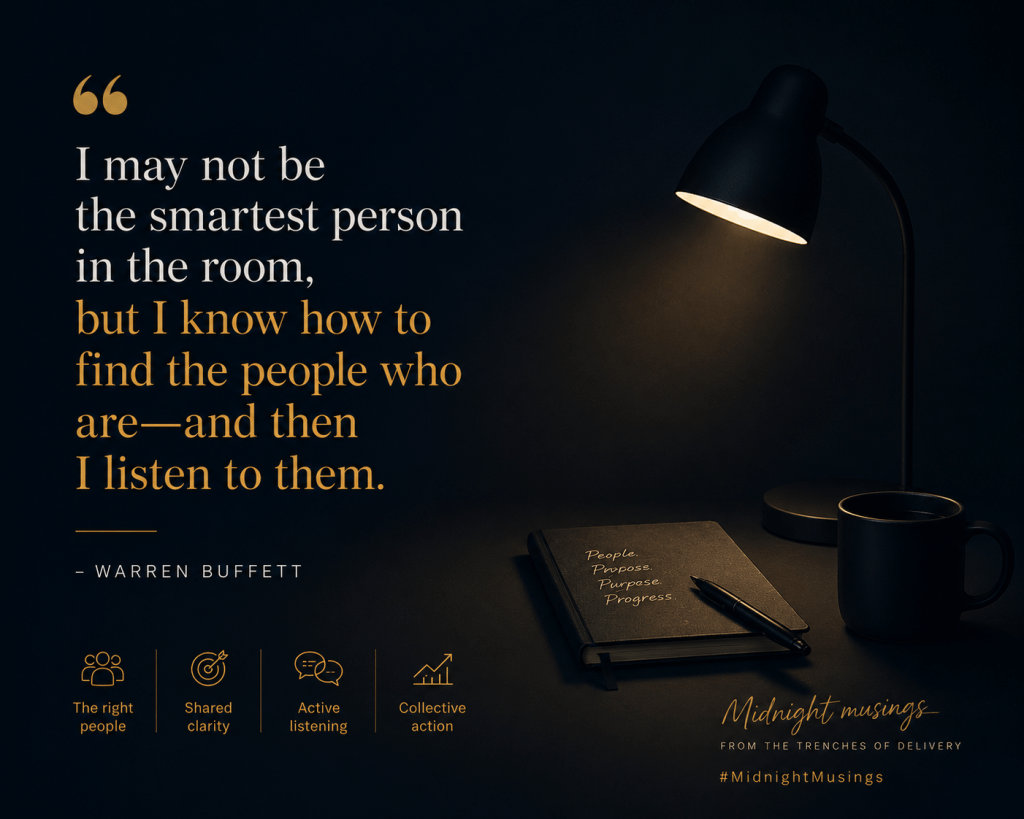
    There’s a quote often attributed to Warren Buffett: “I may not be the smartest person in the room, but I know how to find the people who are—and then I listen to them.”

    That line pretty much sums up what makes a strong program manager. The role isn’t about being the technical expert or having all the answers. It’s about judgment—knowing how to bring together the right people, create clarity, and move everyone toward a shared goal.

    The best program managers don’t dominate the room; they orchestrate it. They turn expertise into alignment, and alignment into execution.

    Humility, clarity, action. That’s the quiet core of real leadership.

    — Midnight musings from the trenches of delivery.

    #Midnight-Musings