Tag: Delivery Leadership

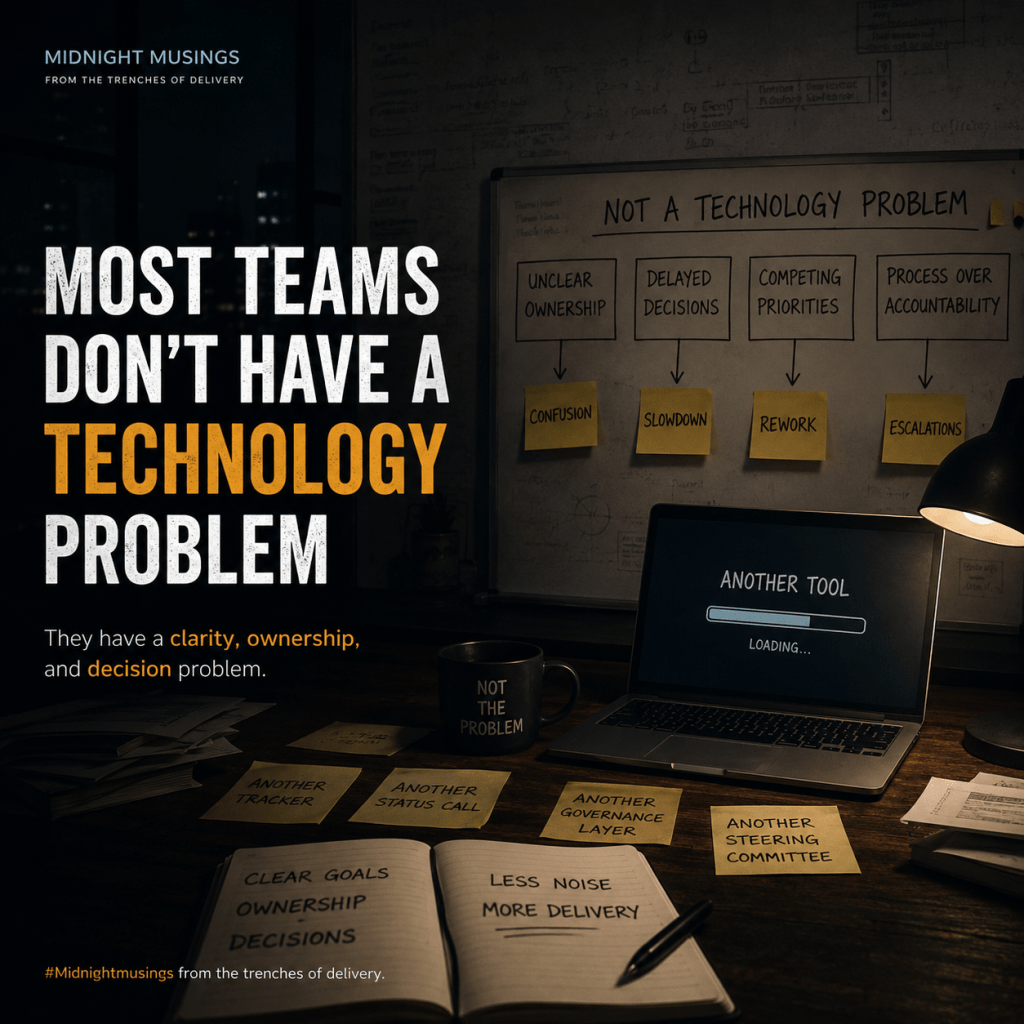
  • Most Teams Don’t Have a Technology Problem

    Most Teams Don’t Have a Technology Problem

    One of the strangest habits in delivery is how quickly troubled programs blame technology.

    Deadlines slip?
    Must be the platform.

    Escalations rise?
    Probably architecture.

    Delivery slows down?
    Clearly a tooling issue.

    But most program failures are not caused by technology limitations.

    They come from unclear ownership, delayed decisions, competing priorities, and teams that slowly normalize confusion.

    The response is usually predictable:

    • another tracker
    • another status call
    • another governance layer

    Because process feels safer than accountability.

    Technology becomes the visible villain because it is easier to debug systems than confront operating behavior.

    Most struggling programs already have good enough technology.

    What they lack is operational clarity.

    Clear ownership.
    Faster decisions.
    Less ambiguity.

    Simple.
    Difficult.
    Rare.

    #Midnightmusings from the trenches of delivery.

  • Right Person. Wrong Role.

    Right Person. Wrong Role.

    One of the hardest parts of leadership is accepting that good people can still be wrong for a role.

    I once heard Girish say:
    “Right person for the right job.”

    Simple sentence. Difficult responsibility.

    Because eventually every leader faces the same uncomfortable reality:
    the person may be hardworking, loyal, and trying their best – and still not be the right fit anymore.

    You see it slowly.
    Missed ownership.
    Repeated escalations.
    The team quietly compensating in the background.

    And this is where leaders hesitate.

    Not because they don’t see the problem.
    Because they do.

    They delay the conversation hoping time will solve what clarity already knows.

    But keeping the wrong person in the wrong role too long is unfair to everyone involved – especially them.

    Hard decisions do not require emotionless leadership.
    They require calm leadership.

    Be prepared with data.
    Be clear.
    Don’t over-explain yourself.

    The best leaders handle difficult decisions quietly.
    No drama.
    No corporate theater.
    Just clarity.

    Because delayed decisions rarely become easier.
    They usually become expensive.

    #midnightmusings from the trenches of delivery.
  • Writing with a Machine

    Writing with a Machine

    I like to think I write reasonably well.

    The vocabulary is there. The ideas usually show up. But over the past year, most of my emails, presentations, and even these Midnight Musings have had a quiet collaborator – AI.

    Not because I can’t write.

    Because it gets me to the point faster.

    Left to myself, I tend to wander through sentences and circle the idea before landing on it. AI trims the fluff, tightens the structure, and pushes the message to its conclusion.

    It doesn’t replace thinking. It compresses it.

    There’s a quote often attributed to Mark Twain: “I didn’t have time to write a short letter, so I wrote a long one instead.”

    Clarity takes work. Brevity takes more.

    AI just helps remove everything that isn’t the message.

    And in a world drowning in words, that might be its most useful skill.

    #midnightmusings from the trenches of delivery.

  • Still Working on It

    Still Working on It

    Escalation calls are every program manager’s rite of passage. You join with no solution, an angry customer, and the uneasy feeling that your only update is still, “We’re working on it.”

    About nine years ago, I was in one of those situations on a BI project. A critical issue had dragged on for weeks. Three weeks in, I took a pause — stopped defending, turned my camera on, and just listened. I acknowledged their frustration and was honest about what we were trying, where we were stuck, and what we still didn’t know.

    Eventually, when we finally resolved the issue, the real outcome was unexpected — they trusted me more than before. Somehow, the escalation built a stronger relationship instead of breaking it.

    Customers understand technical challenges; they’ve faced them too. When you’re transparent — when you say, this is the problem, this is what we’re trying, and we don’t yet have the answer — you build trust even when things are breaking.

    So the next time you walk into one of those fiery calls, remember — you don’t always need a solution. Sometimes, you just need to listen.

    — Midnight musings from the trenches of delivery.

    #Midnight-Musings