Tag: Business Strategy

  • AI Has Changed The Cost of Waiting

    AI Has Changed The Cost of Waiting

    In the last post, I wrote about how the people winning with AI aren’t necessarily the best coders.

    They’re the people who understand their domain deeply enough to build.

    But there’s another shift happening underneath that.

    Speed.

    A few months ago, I watched two very different approaches to the same AI-driven idea.

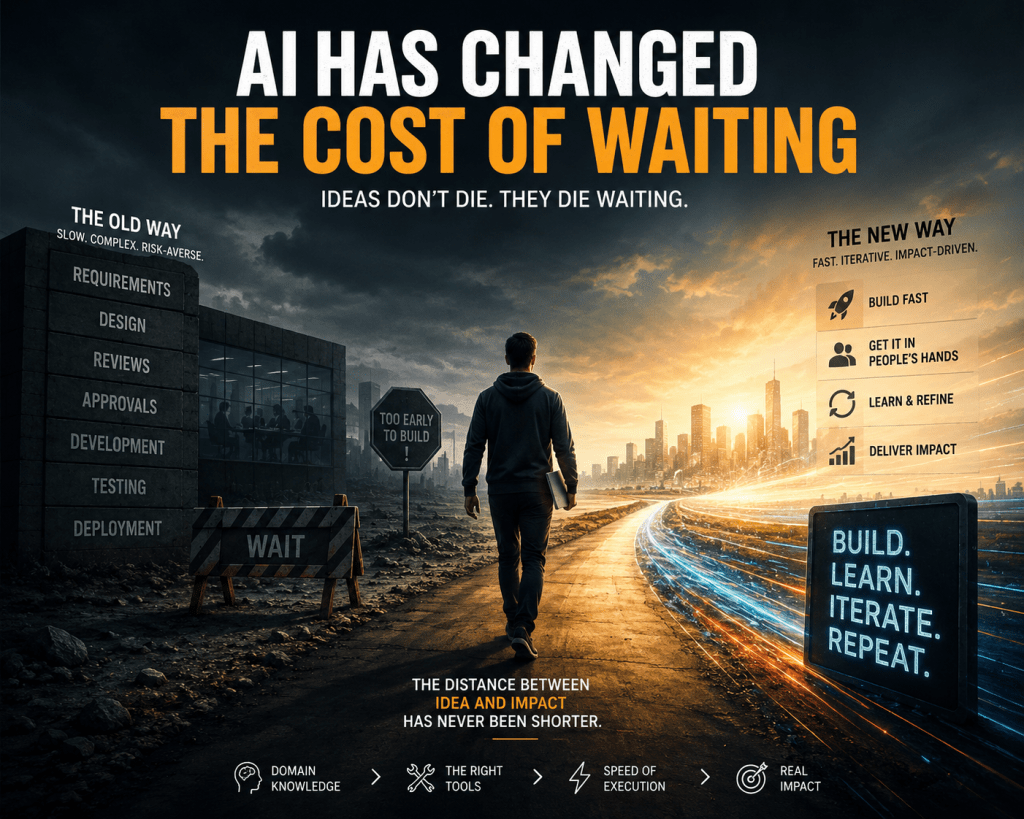
    One treated it like a traditional software project:
    planning, reviews, alignment, architecture discussions, phased execution.

    The other approach was simpler:
    build fast, get it into people’s hands, refine as you go.

    That contrast stayed with me.

    Because AI is collapsing the distance between idea and execution.

    A domain expert with clarity and the right tools can now prototype faster than many organizations can align internally.

    And that changes things dramatically.

    The advantage is no longer just technical skill.

    It’s speed of understanding.
    Speed of iteration.
    Speed of decision-making.

    Many organizations are still operating with waterfall thinking in a world where experimentation has become almost free.

    AI rewards people who are hands-on.
    People close to the actual business problem.
    People willing to fail fast and refine in public.

    Which raises an uncomfortable question:

    If everyone starts building this quickly, what happens to stability, architecture, governance, and long-term maintainability?

    That’s probably where the real conversation begins.

    #Midnightmusings from the trenches of delivery.
  • The People Winning With AI Aren’t the Best Coders

    The People Winning With AI Aren’t the Best Coders

    That’s the wrong conversation.

    A few years ago, building software meant technical skill. You needed engineers, architects, specialists, infrastructure teams, databases, deployment pipelines – the whole machinery.

    Now?

    You can build surprisingly complex workflows, dashboards, automations, apps, even lightweight platforms using plain language. Tools like ChatGPT, Gemini, Claude, Cursor, Lovable, Replit – they’ve flattened the technical barrier faster than most organizations realize.

    The bottleneck is no longer execution.

    It’s understanding.

    A few weeks ago, Girish made an observation that stuck with me:

    “Knowing your domain is becoming more important than being technically excellent.”

    And honestly, that might be the biggest shift AI is creating right now.

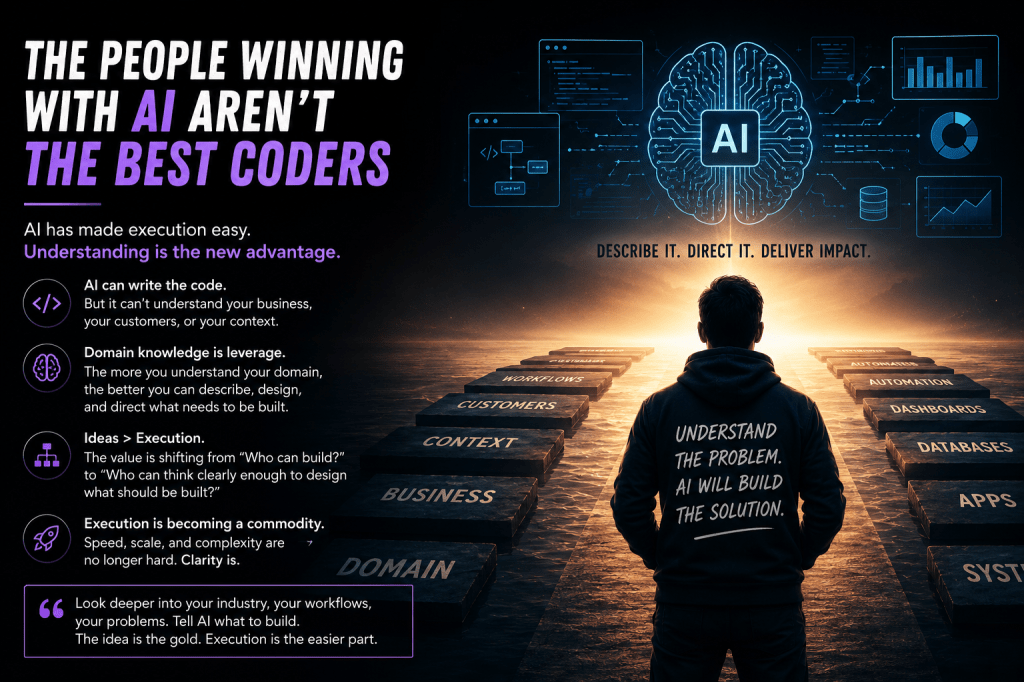
    The people getting ahead with AI aren’t necessarily the best programmers. They’re the people who deeply understand their domain. Their customers. Their workflows. Their operational pain points. Their industry logic.

    Because AI can generate code.

    But it cannot invent clarity.

    If you truly understand how your business works, you can now describe it, structure it, refine it, and have AI build around it at absurd speed.

    That changes the game completely.

    The value is shifting from “Who can build?” to “Who can think clearly enough to design what should be built?”

    Ideas are becoming leverage.

    Context is becoming leverage.

    Conceptualization is becoming leverage.

    Execution is slowly turning into the cheaper commodity.

    And that creates a second shift that most organizations still haven’t fully understood:

    When execution becomes easier, speed starts mattering more than process.

    The teams that learn fastest may soon outperform the teams that plan the longest.

    And honestly, that changes leadership, delivery, and product development more than AI itself.

    More on that in the next post.

    #Midnightmusings from the trenches of delivery.