Tag: accountability

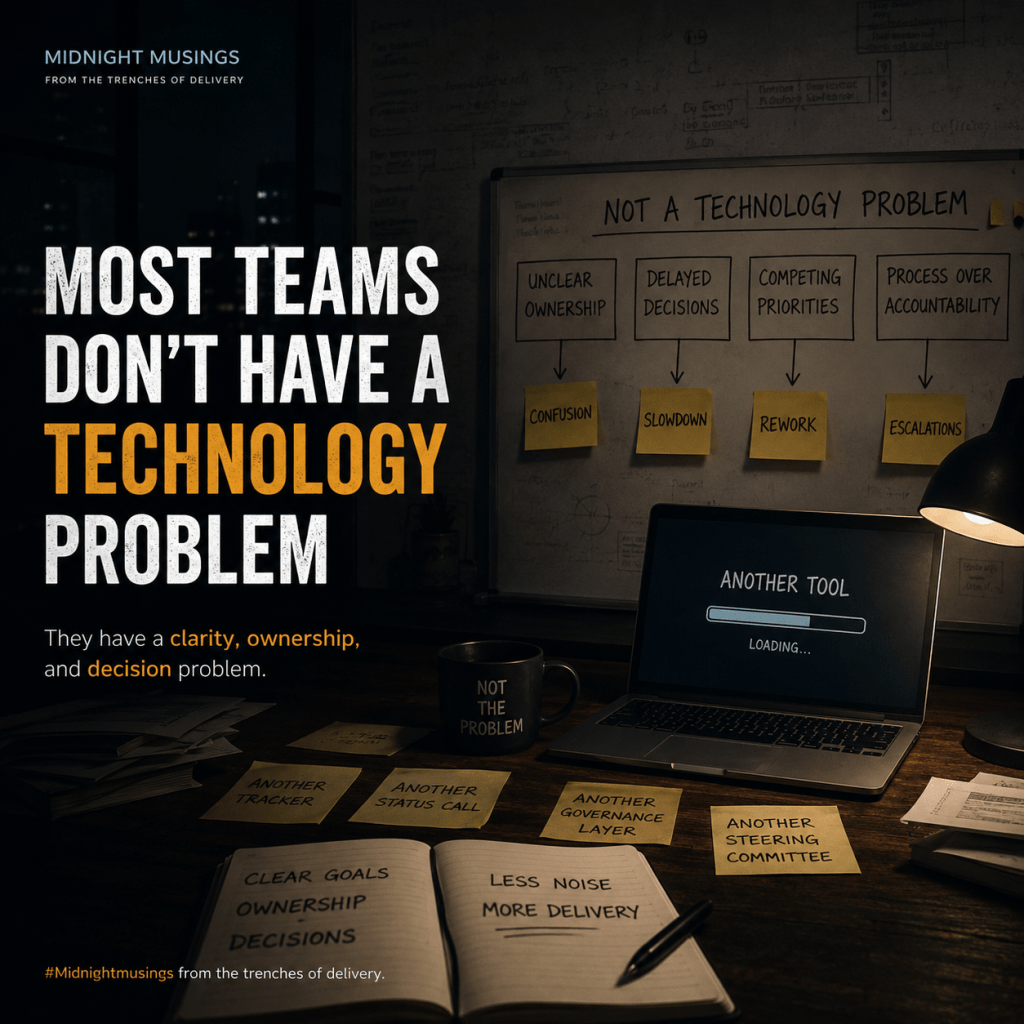
  • Most Teams Don’t Have a Technology Problem

    Most Teams Don’t Have a Technology Problem

    One of the strangest habits in delivery is how quickly troubled programs blame technology.

    Deadlines slip?
    Must be the platform.

    Escalations rise?
    Probably architecture.

    Delivery slows down?
    Clearly a tooling issue.

    But most program failures are not caused by technology limitations.

    They come from unclear ownership, delayed decisions, competing priorities, and teams that slowly normalize confusion.

    The response is usually predictable:

    • another tracker
    • another status call
    • another governance layer

    Because process feels safer than accountability.

    Technology becomes the visible villain because it is easier to debug systems than confront operating behavior.

    Most struggling programs already have good enough technology.

    What they lack is operational clarity.

    Clear ownership.
    Faster decisions.
    Less ambiguity.

    Simple.
    Difficult.
    Rare.

    #Midnightmusings from the trenches of delivery.

  • Right Person. Wrong Role.

    Right Person. Wrong Role.

    One of the hardest parts of leadership is accepting that good people can still be wrong for a role.

    I once heard Girish say:
    “Right person for the right job.”

    Simple sentence. Difficult responsibility.

    Because eventually every leader faces the same uncomfortable reality:
    the person may be hardworking, loyal, and trying their best – and still not be the right fit anymore.

    You see it slowly.
    Missed ownership.
    Repeated escalations.
    The team quietly compensating in the background.

    And this is where leaders hesitate.

    Not because they don’t see the problem.
    Because they do.

    They delay the conversation hoping time will solve what clarity already knows.

    But keeping the wrong person in the wrong role too long is unfair to everyone involved – especially them.

    Hard decisions do not require emotionless leadership.
    They require calm leadership.

    Be prepared with data.
    Be clear.
    Don’t over-explain yourself.

    The best leaders handle difficult decisions quietly.
    No drama.
    No corporate theater.
    Just clarity.

    Because delayed decisions rarely become easier.
    They usually become expensive.

    #midnightmusings from the trenches of delivery.

  • Ruthless Simplicity. Relentless Execution.

    Ruthless Simplicity. Relentless Execution.

    Most delivery problems don’t start with technology. They start with process drift.

    Over time, organizations quietly accumulate layers – another tracker, another template, another governance step added after a crisis. None of it feels unreasonable in the moment. But eventually delivery teams spend more time navigating process than delivering outcomes.

    At some point, someone has to ask: Is this actually helping?

    Recently, our COO Arun Chandra framed operational excellence around three principles – Ruthless Simplicity, Crystal Clear Accountability, and Relentless Execution.

    Simple words. Hard in practice.

    Because Simplicity forces you to remove things. Accountability forces you to name owners. Execution forces you to stop admiring frameworks and start delivering.

    As part of our #AIFirst initiative, we redesigned the NICE Actimize XSE delivery governance model.

    Instead of adding reporting layers, we introduced an AI-driven governance layer across the delivery lifecycle – analyzing signals from risks, timelines, and project updates to surface issues early.

    In practice, it meant collapsing multiple trackers into a single lifecycle model and letting AI highlight emerging risks before they become escalations.

    The goal isn’t more governance.

    It’s better visibility with less friction.

    #Midnightmusings from the trenches of delivery.