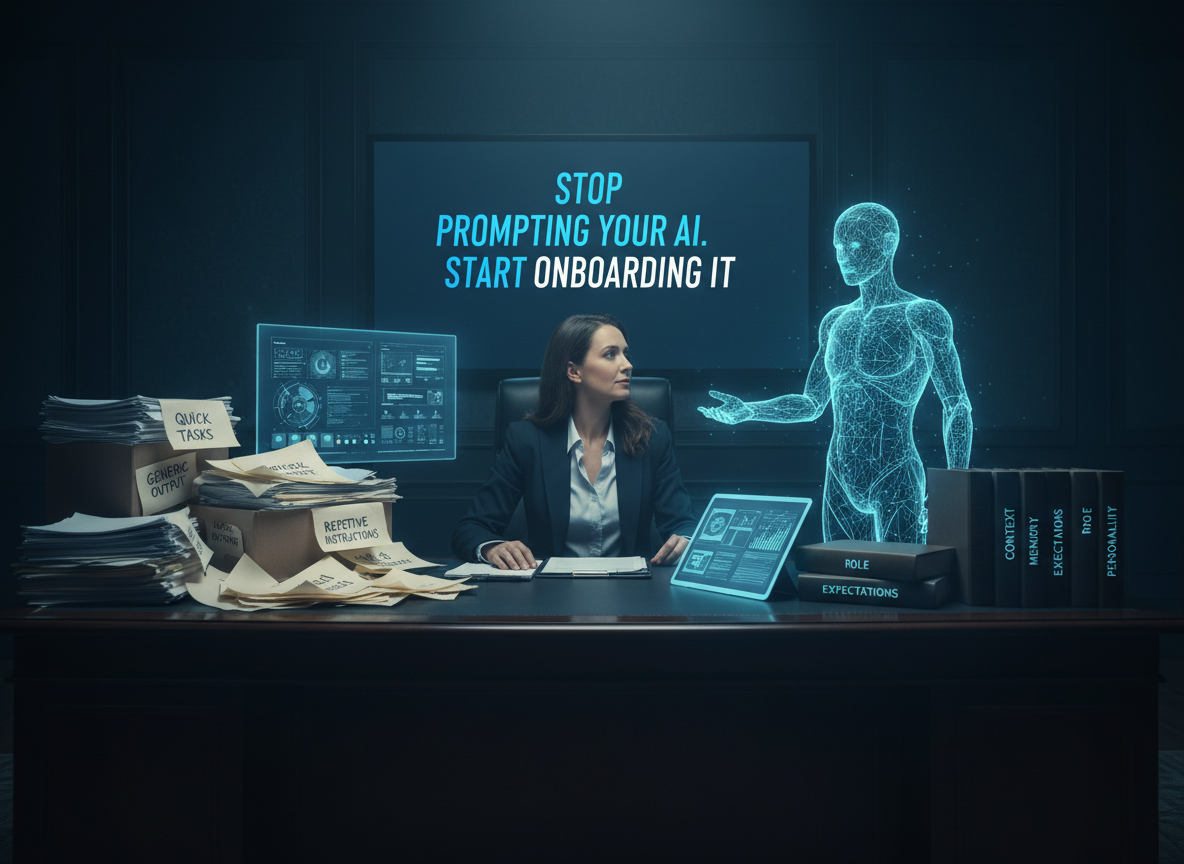
The more I use AI, the less I think about prompts. Sounds backwards. It isn’t.
It’s 8:40am on a Monday.
A new colleague joins your team. Experienced. Sharp. The kind of hire you fought to get.
You walk over, drop a single sentence on their desk – “I need the risk summary for the steering meeting by four” – and walk away.
No background. No customer history. No last month’s status. No sense of who’s in the room at four, or what actually keeps them up at night.
At 3:58pm, it lands in your inbox.
It’s… fine. Technically correct. Neatly formatted. And completely generic. It tells you what happened. It doesn’t tell you what matters. It walks straight past the two things you actually needed decided.
Would you blame the new hire? Of course not. You’d blame the onboarding.
And yet – this is exactly how most of us use AI. We hand it a task, give it almost nothing, expect brilliance, and then mutter that “AI isn’t that good for our kind of work.“
The problem is rarely the intelligence in the room. It’s the brief.
AI doesn’t need a better prompt. It needs better context.
When people find out how much I lean on AI at work, they usually want my prompts. The magic words. The secret template. They look genuinely let down when I tell them the prompt is the least interesting part.
The biggest jump in how I use AI had nothing to do with cleverer phrasing. It came from one boring shift: I stopped treating AI like software, and started treating it like a new team member.
You don’t fling work at a new joiner on day one. You sit them down. You explain what you’re trying to achieve, who the stakeholders are, how decisions really get made, what “good” looks like, which landmines to avoid. Then you let them run.
AI deserves the same courtesy. And the results scale with the briefing, not the wording.
The quiet shift: from Prompt Engineering to Context Engineering
For a few years the whole conversation has been about Prompt Engineering – how to phrase the perfect instruction.
It worked. Better prompts do give better answers.
But a related discipline is becoming increasingly important: Context Engineering; deliberately giving AI the knowledge, history and constraints it needs to understand a problem before you ask it to solve one.
Prompt Engineering tells AI what you want it to do. Context Engineering gives AI what it needs to know before doing it.

Take a request I make constantly: “Review this and give me the three biggest risks.”
I could spend ten minutes perfecting that sentence. Or I could give it something far more useful – the objectives, the last few updates, the key decisions, the customer commitments, the open issues, and what’s already gone wrong.
The prompt didn’t get smarter. The model didn’t get smarter. But the answer almost certainly did.
Information isn’t the same as context
Anyone who’s joined something halfway through knows this in their bones.
You get the shared drive link. You read the reports, the plan, the minutes. Hours of heroic document-reading later, you technically possess a mountain of information – and still can’t say why the team is doing what it’s doing.
Because the most valuable context is rarely in a document. It’s the history behind a decision. The tension between two stakeholders. The thing that was tried six months ago and blew up. The reason the “obvious” option isn’t actually on the table.
Information tells you what happened. Context tells you why it matters.
For small tasks – rewrite this email, summarise that doc – the task itself carries enough. But the moment you ask AI to analyse a situation, challenge your thinking, or connect today with a decision made three weeks ago, the depth of its context is everything.
How I actually onboard AI – in five steps
This is the routine I run before asking AI for anything that matters. It adds minutes to the front of the task and can save hours on the back end. Whether you’re a fraud analyst, a compliance lead, a project manager, or in sales.

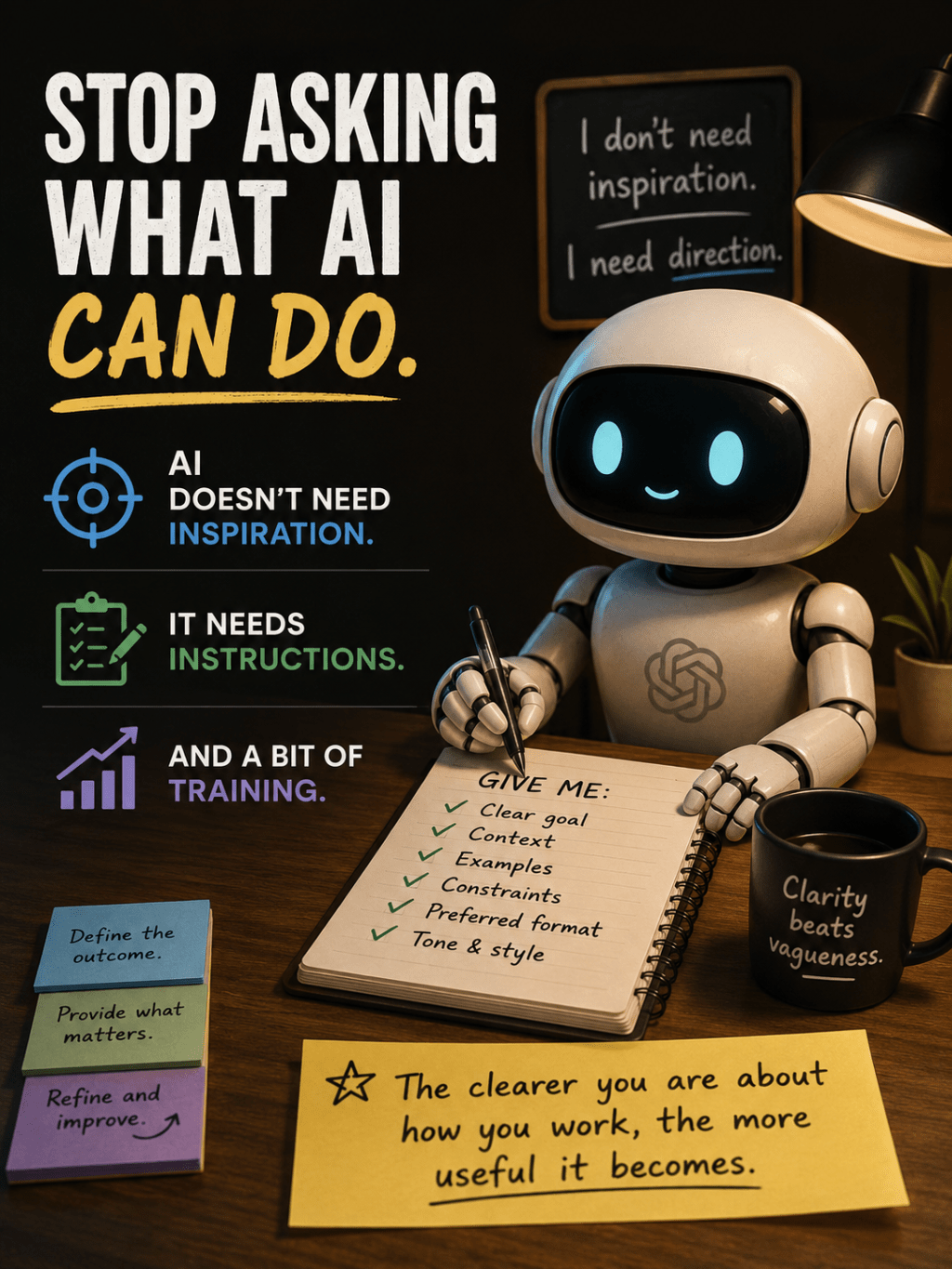
1. Hire it for a role, not a task. Don’t say “write a project update.” Say “You’re a program manager briefing an executive committee that cares about outcomes, risk, budget and the decisions that need attention today.” Need a different brain? Hire a different person – a business analyst, a skeptical customer CIO, a risk manager. Same AI, different seat, completely different answer.
2. Finish the onboarding. Hand it what you’d hand a real joiner: the objectives, the recent history, the open issues, the stakeholders, and – quietly one of the most useful – how this particular customer likes to be communicated with.
3. Tell it what “good” looks like. AI rarely struggles to do the work; it struggles to know what good is. So spell it out: highlight only material changes, challenge the optimistic assumptions, keep it under a page, recommend a decision – don’t just narrate status.
4. Coach the first draft. Don’t stop at the first answer. Turn around and interrogate it: What did you assume? Which risk haven’t we surfaced? If you were the customer, what would worry you? Which of your own recommendations is weakest? This is where it stops being a writing tool and starts being useful – not because it writes well, but because it critiques well.
5. Let it keep the memory. Good people compound because they remember. Keep the context alive – living docs, a decision log, lessons learned – so every conversation starts where the last one ended.
And you don’t need a complicated AI stack to do this. If you have Microsoft Copilot, you already have most of what you need to start. Bring the relevant project documents, meeting notes, plans and status reports into the conversation or approved workspace, give Copilot the role and success criteria, and then start asking it to challenge your thinking.
What a good brief actually looks like Role: You’re a compliance analyst preparing a summary for the MLRO. Context: here’s the alert history, the policy, last quarter’s findings, the customer profile. What “good” means: flag only material changes, call out anything inconsistent, recommend an action – keep it to half a page. Then ask. Then coach. Two extra minutes of briefing saves twenty minutes of rewriting.
This isn’t just my habit – it’s where everything is heading
Context Engineering isn’t a personal quirk. Most of the AI around us is already evolving toward it.
Projects in ChatGPT and Claude let your files and history live around your work. Gemini Notebook reasons inside a stack of sources you choose. GitHub Copilot works with the surrounding codebase, not orphaned snippets. And it’s in your pocket too – Siri learning across your messages and mail, Gemini drawing on Gmail, Photos and Calendar.

Different tools, same direction: AI gets more useful when it understands the environment the question lives in.
Security Considerations
One important line in the sand, though – especially at a company like ours. Context Engineering is not a license to paste sensitive material into whatever AI tab is open. Customer data, confidential information, source code and IP stay inside approved tools and our security policies. The goal was never maximum context. It’s the right context, securely, at the right moment.
A better question to ask
Prompt Engineering isn’t going away. Clear instructions always matter.
But next time AI hands you a mediocre answer, resist the reflex to rewrite the prompt. Ask instead:
What do I know that the AI doesn’t?
The history in your head. The constraint you never spelled out. What “good” looks like to you. What you’d tell a sharp colleague before handing them the same task. Give AI that, and ask again.

Before your next AI conversation, don’t open with the task. Open with the onboarding – five quick questions:
• Who have I hired it to be?
• What does it need to know first?
• What does “good” look like here?
• How will I coach the first draft?
• What should it remember for next time?
You’ll spend two extra minutes briefing it. You’ll save twenty rewriting it. And somewhere in there, you’ll stop treating AI as software that answers questions – and start treating it as a teammate that helps you solve them.
Which leaves the question I keep circling back to: if context makes AI this much better, how do we stop rebuilding it from scratch every single conversation?
That’s where the idea of a Second Brain starts to get interesting.
But that’s for another day.
Midnight Musings... from the trenches of delivery.
https://www.linkedin.com/pulse/stop-prompting-your-ai-start-onboarding-rahul-majumdar-7saaf



 Midnight Musings